Cash Offer Vs Listing With Realtor In Scottsdale: Fair Cash Offers Guaranteed
Weighing a cash offer vs listing with a realtor in Scottsdale? See the real net proceeds on a $965K home, true costs, and which option actually fits your situation.

Senior Contributor, NestCash··11 min read
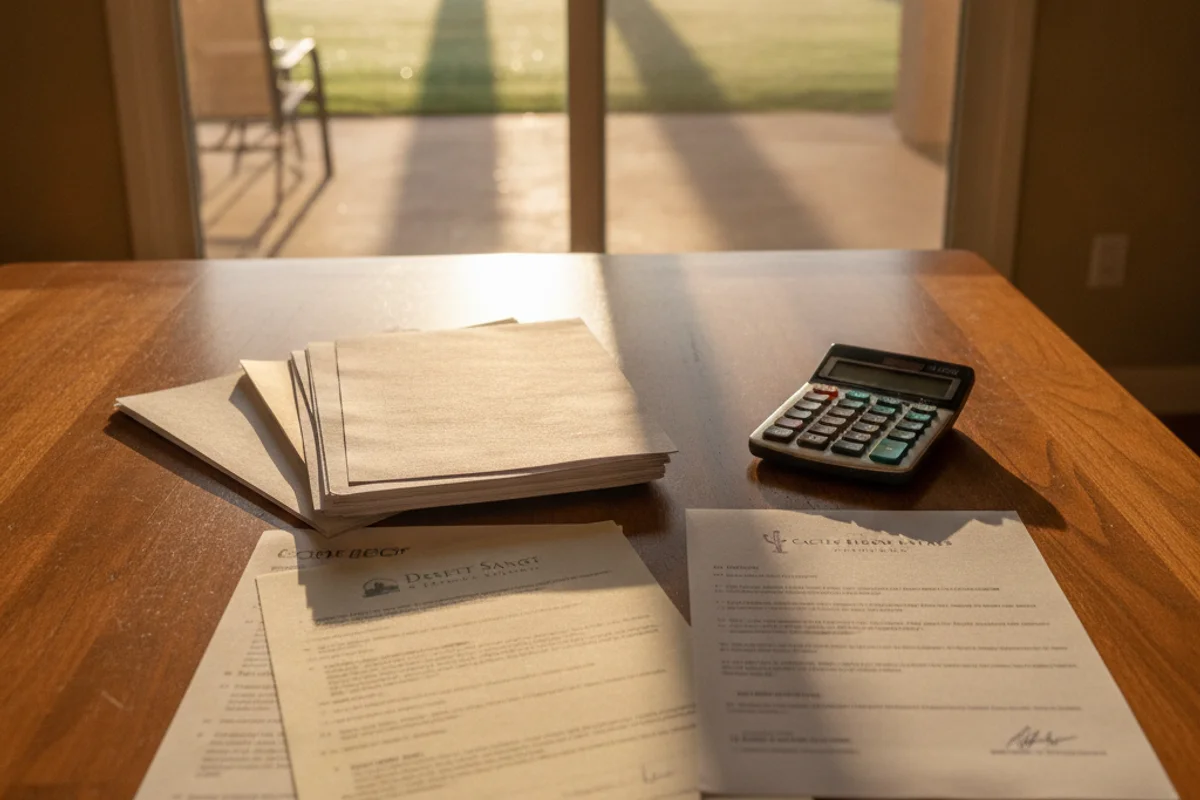
Here’s a myth worth busting before you call an agent or request a cash offer: listing your Scottsdale home on the open market does not automatically put more money in your pocket. When you’re weighing a cash offer versus listing with a realtor in Scottsdale, the math gets complicated fast. Commissions, repair credits, two-plus months of carrying costs, and the occasional blown deal can quietly erase tens of thousands in theoretical gains. This article breaks down every dollar so you can make a clear-eyed decision based on real numbers, not assumptions that favor one path over the other.
”Listing Always Gets More Money”, Is That True in Scottsdale?
The short answer: sometimes, but not always. In Scottsdale’s current market, the gap is smaller than most sellers expect, and for certain homeowners, it disappears entirely.
With a median home price of $965,000 and an average of 58 days on market, Scottsdale is stable but not frenzied. Homes are selling, but they’re not flying off the shelves in a week. That timeline matters enormously when you’re paying a mortgage, HOA fees, property taxes, and utilities on a home you’re trying to exit. Every additional week on market is a week you’re funding two households or absorbing ownership costs on a property you no longer want.
Let’s put both options side by side so you can see exactly what we’re talking about, with real numbers anchored to Scottsdale’s current median price.
Side-by-Side Net Proceeds Comparison
| Traditional Listing | Cash Offer | |
|---|---|---|
| Sale / Offer Price | $965,000 | $820,250 (85% of value) |
| Agent Commission (6%) | -$57,900 | $0 |
| Closing Costs (3%) | -$28,950 | $0 |
| Typical Repairs | -$19,300 | $0 |
| Carrying Costs (2+ months) | -$9,000+ | $0 |
| Estimated Net | ~$849,850 | ~$820,250 |
| Timeline | 90-120 days | 7-14 days |
The gap on a $965,000 Scottsdale home is roughly $29,600 in favor of listing, after accounting for the most common costs. That’s real money and you shouldn’t dismiss it. But it’s not $144,750, which is what sellers often assume when they first see an 85% cash offer and mentally subtract it from full asking price. More importantly, that $29,600 assumes nothing goes sideways during the listing process, which brings us to the details that actually move this number.
Get Your Free Cash Offer Today
No fees. No repairs. Close in as little as 7 days.
Related Video
Breaking Down the 6% Commission and What Else You Pay
Agent commission is the single largest line item in any traditional sale. On a $965,000 Scottsdale home, a standard 6% commission totals $57,900, paid at closing out of your proceeds. Per NAR research, commission rates have seen some downward pressure nationally following recent industry changes, but 5-6% remains the norm for full-service representation in Arizona, particularly in the luxury price ranges common to Scottsdale.
Beyond commission, you’re also responsible for closing costs on the seller side. According to Bankrate’s closing cost data by state, Arizona sellers typically pay 2-3% of the sale price in closing costs. That includes escrow fees, title insurance, recording fees, and transfer taxes. On a $965,000 home, that’s another $19,300 to $28,950 leaving your pocket at the closing table.
Then there’s pre-listing prep, which rarely makes it onto seller spreadsheets but is very real. Professional photography, staging consultations, minor cosmetic updates, and landscaping touch-ups for curb appeal all cost money. In North Scottsdale neighborhoods like DC Ranch, McCormick Ranch, or Gainey Ranch, buyers at this price point expect a certain level of polish and presentation. Budget conservatively at $3,000-$7,000 for pre-market preparation, and that’s before an inspector finds a single thing wrong with the property.
Cash buyers cover their own closing costs and charge you zero in commissions. The offer price is the number that goes into your bank account, minus any seller concessions, which are rare in a properly structured cash transaction. There are no hidden deductions waiting for you at the closing table.
How Repair Requests Eat Into Your Scottsdale Sale Proceeds
This is where traditional sales quietly bleed money, and it catches a lot of sellers off guard, particularly those who haven’t sold a home in a decade or more.
After a buyer’s inspection, a repair request is almost guaranteed. In Arizona, this document is called the Buyer’s Inspection Notice and Seller’s Response, or BINSR. Buyers inspect everything, and they negotiate hard, especially in the $900,000-plus price range where they feel entitled to a turnkey property. Scottsdale homes built in the 1980s and 1990s, which are common throughout Old Town, the Scottsdale Ranch corridor, and Shea Boulevard neighborhoods, often surface issues with aging HVAC systems, pool equipment, flat roof sections, or outdated electrical panels.
Repair costs at this price tier are not small. The average repair credit or fix in a Scottsdale luxury sale falls in the $10,000-$25,000 range. Our comparison table uses $19,300, which is actually conservative for a home priced near $1 million.
Arizona also requires sellers to complete a Seller’s Property Disclosure Statement under ARS 33-422. This legally mandated document requires you to disclose known material defects, property conditions, and any issues that could affect the home’s value or desirability. Buyers and their agents review this carefully, and honest disclosures can prompt additional negotiation leverage. Termite inspections are also standard in Maricopa County given the desert climate, and if activity is found, treatment and repair costs typically land on the seller’s side of the ledger.
The BINSR negotiation phase alone can drag a transaction out by one to three additional weeks while both sides argue over credits versus repairs versus price reductions. If you’d rather skip every bit of that, an as-is home sale in Scottsdale through a cash buyer eliminates every inspection contingency and repair negotiation entirely. No BINSR. No credits. No last-minute surprises two weeks before your planned close date.
Find Out What Your Home Is Worth
Get a no-obligation cash offer in 24 hours.
The Carrying Cost Math: What Every Extra Month Costs in Scottsdale
This is the cost nobody voluntarily puts on the spreadsheet, and it matters more in Scottsdale’s current market than sellers tend to realize.
At 58 days on market plus 30-45 days to close a financed deal after offer acceptance, you’re realistically looking at 90-120 days from list date to funded sale. That’s three to four months of ongoing homeownership costs on a home you’re no longer living in or planning to keep.
Here’s a concrete look at what two to three months of carrying costs looks like on a typical Scottsdale home in this price range:
- Mortgage payment (principal and interest at current rates): approximately $4,200-$4,800 per month
- HOA fees, which are common in master-planned communities like Gainey Ranch, DC Ranch, and McCormick Ranch: $300-$600 per month
- Utilities including electricity for desert cooling, which runs high in summer: $300-$400 per month
- Property taxes prorated monthly on a $965,000 home: approximately $380-$420 per month
Total monthly carrying cost lands between $5,180 and $6,220, depending on your specific loan and HOA situation. Over three months, that’s $15,540-$18,660 coming directly out of your actual net proceeds. Over four months, the number approaches $21,000-$25,000.
Those figures don’t appear on your settlement statement as a line item, but they come directly out of your pocket during the listing period. When you factor carrying costs into the comparison honestly, the real gap between a $820,250 cash sale and a $849,850 traditional listing net can shrink to $10,000 or less. For some Scottsdale sellers, that margin simply isn’t worth three to four months of management, uncertainty, and stress.
A cash sale closes in 7-14 days. You stop paying carrying costs the day you close. That time value is real money, and it deserves a dedicated line in your calculation.
Why Cash Offers Are More Competitive in Arizona Than You Think
Scottsdale has one of the highest cash sale rates in the Southwest. Approximately 33% of all home sales here close without financing, which is more than double the national average of roughly 15%. That’s not a fluke. It reflects the specific buyer profile that Scottsdale consistently attracts.
Affluent retirees relocating from California, the Pacific Northwest, or the Midwest. Second-home buyers purchasing a desert retreat. Luxury investors adding to their portfolio. Remote workers who sold a high-value primary residence and are rolling significant equity into their next purchase. Many of these buyers simply don’t need a mortgage. That dynamic makes cash offers culturally normal in Scottsdale in a way they aren’t in most other markets across the country.
What does that mean for you as a seller? A cash offer from a qualified home buyer is not a lowball insult. It’s a legitimate transaction type that one in three Scottsdale sellers accepts every single year. And because cash transactions are non-contingent, you eliminate the two biggest deal-killers in any real estate transaction: financing fall-through and appraisal gaps.
In financed deals, Arizona appraisals can derail everything at the worst possible moment. If a buyer’s lender appraises your home below the agreed offer price, you either renegotiate the price, agree to split the gap with the buyer, or watch the deal die and start over. That scenario is not rare. With a cash buyer, there is no appraisal. No underwriter reviewing your roof condition. No lender calling for repairs before they’ll fund. The offer you accept is the transaction that closes.
If you want to explore what Scottsdale cash home buyers can offer for your specific property, the evaluation process is faster and simpler than most sellers expect. You can also learn how cash buyers operate throughout the state when you sell a house in Arizona and compare your local options side by side.
We also work with homeowners in nearby Mesa, Phoenix, and Maricopa who are running the same comparison in their own local markets, so the decision framework here applies broadly across the Phoenix metro area.
Making Your Decision: Cash or List in Scottsdale?
There’s no universal right answer here, and anyone who tells you otherwise is oversimplifying. The best choice depends on your specific situation, your timeline, your financial cushion, and how much risk you’re willing to absorb during the listing process.
Listing with a realtor makes more sense when:
- Your home is in excellent, updated condition with no deferred maintenance and a recently serviced HVAC and pool system
- You have 3-4 months of financial flexibility and can comfortably absorb carrying costs without stress
- You’re in a high-demand Scottsdale neighborhood like the 85255 zip code, Paradise Valley adjacent streets, or a premium DC Ranch enclave where multiple-offer situations still occasionally occur
- Maximizing the final sale price is your top priority and you’re prepared to manage the entire process, including showings, negotiations, and potential re-listing if a deal falls through
A cash offer makes more sense when:
- You need to sell your house fast in Scottsdale due to a job relocation, divorce, inherited property, or mounting financial pressure
- Your home needs repairs you can’t afford, don’t have time to manage, or simply don’t want to deal with
- You’ve already had a financed deal fall through once and want certainty this time around
- You’re managing the sale remotely from another state and can’t coordinate showings, contractor visits, or inspection walkthroughs
- You’re approaching foreclosure and need a fast, clean exit (our guide on avoiding foreclosure in Phoenix covers how time-sensitive sales work in similar high-pressure situations)
The most practical first step is to get your cash offer from a local buyer, then run the honest comparison against what a traditional listing would actually net you after commissions, closing costs, likely repair credits, and three-plus months of carrying costs. You might find the difference is smaller than you assumed. Or you might find that listing is clearly the better financial move for your specific property and timeline. Either way, you’ll be deciding with real numbers on both sides of the ledger.
One last thing worth knowing: Scottsdale’s market is currently stable with moderate inventory. That’s not a screaming seller’s market, and it’s not a buyer’s market either. Homes are sitting for nearly two months on average before an offer materializes. That means your listing is not guaranteed to generate a bidding war or a quick clean offer. Price it slightly above market, list during the slower summer months when snowbirds have returned north, or hit the market with visible deferred maintenance, and 58 days can easily stretch to 90 or 120.
Run the full math for your actual home. Factor in your real monthly costs, a realistic repair estimate based on your home’s age and condition, and a conservative sale timeline. When you do that calculation honestly, the right path usually becomes clear without anyone having to push you in either direction.
For more on selling without repairs in Arizona, read our full breakdown of as-is home sales in Scottsdale. Arizona disclosure requirements are outlined under ARS 33-422 and explained in plain English by Nolo’s guide to Arizona seller disclosures.
NestCash works with Scottsdale homeowners dealing with divorce, foreclosure, inherited properties, and homes that need to sell as-is every single day.
Ready to Sell? Let's Talk.
Get your cash offer now. No obligation, no hassle.

Lisa is a Senior Contributor at NestCash, writing expert content on real estate, homeownership, and market trends. She covers 12 states, with a focus on making real estate information practical, clear, and useful.