Cash Offer Vs Listing With Realtor In Miami: Any Condition, Cash Offer
Miami homes average 107 days on market. Compare actual net proceeds from cash offers vs realtor listings with real numbers, fees, and timelines.

COO & Correspondent, NestCash··12 min read
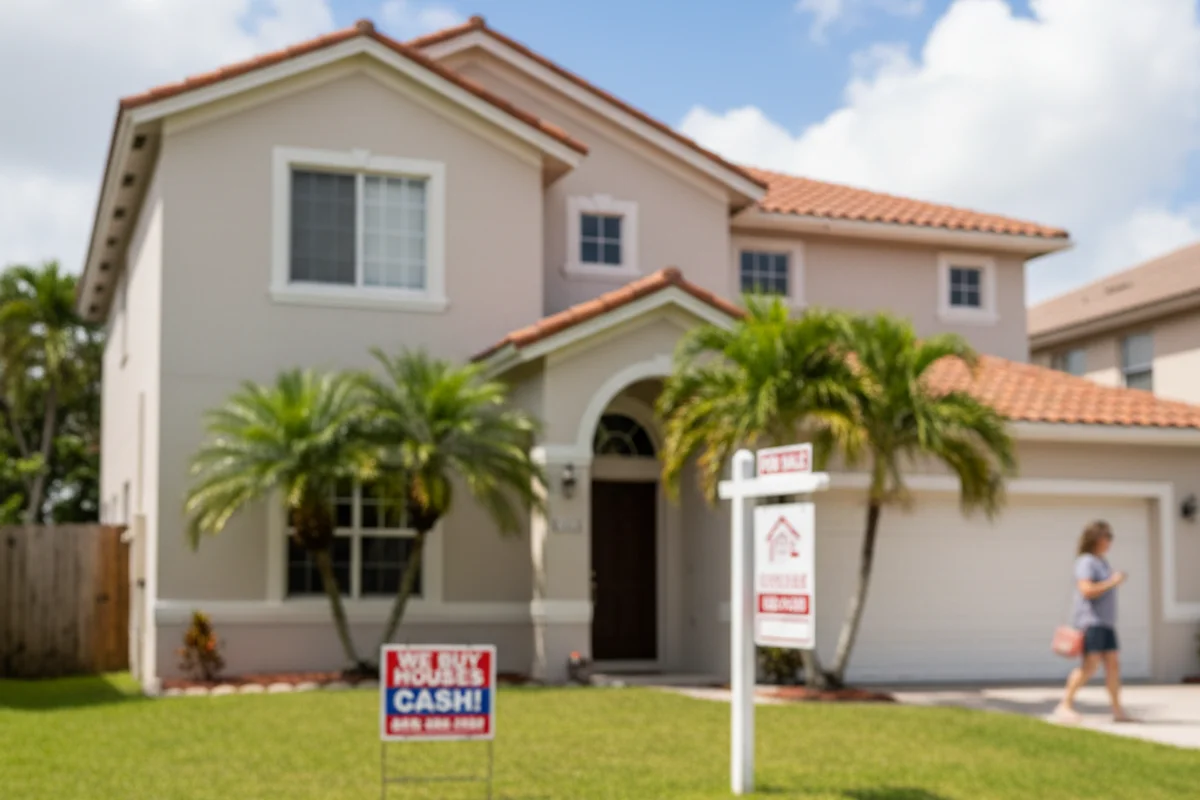
Miami sellers who accept list prices below asking price see their homes linger 107 days on average before closing. That stat tells you something important about your decision between a cash offer vs listing with a realtor in Miami. The longer timeline isn’t just inconvenience. It’s carrying costs, maintenance, insurance, and opportunity cost that compound daily.
Let’s look at what you actually keep from each option using real Miami numbers.
What Miami’s Current Market Tells You About Your Best Option
Miami’s median home price sits at $675,000 with moderate inventory levels. The market has stabilized after years of volatility, meaning you’re neither racing against rapid appreciation nor watching your equity evaporate.
Here’s what that means for your net proceeds:
| Cost Category | Traditional Listing | Cash Offer |
|---|---|---|
| Sale/Offer Price | $675,000 | $573,750 (85%) |
| Agent Commission (6%) | -$40,500 | $0 |
| Closing Costs (3%) | -$20,250 | $0 |
| Typical Repairs | -$13,500 | $0 |
| Staging/Prep | -$2,500 | $0 |
| Net Proceeds | $598,250 | $573,750 |
| Timeline | 107+ days | 7-14 days |
The actual difference is $24,500, not the $101,250 gap between your listing price and cash offer. That’s the number you’re really evaluating.
Now add carrying costs. Three and a half months of mortgage payments, insurance, utilities, HOA fees, and maintenance in neighborhoods like Brickell or Miami Beach easily run $4,000, $6,000 monthly. On a $675,000 property, you’re looking at another $14,000, $21,000 in costs during that 107-day average.
Suddenly that gap shrinks to $3,500, $10,500 before accounting for risk.
The good news is Miami’s stable market means you won’t lose ground while listed. You’re not fighting depreciation. But you’re also not gaining equity fast enough to justify waiting if you need to move quickly.

Get Your Free Cash Offer Today
No fees. No repairs. Close in as little as 7 days.
Related Video
How Miami Inventory Levels Affect Your Cash vs. Listing Decision
Moderate inventory creates a balanced market. You have competition, but buyers still have options. This matters more than most sellers realize when comparing paths.
When inventory sits in the moderate range like Miami’s current market, traditional listings perform predictably. You’ll likely get showings. You’ll probably receive offers within 60, 90 days if priced correctly. The system works as designed.
But “works as designed” includes contingencies. According to the National Association of Realtors, approximately 20% of pending home sales fall through nationally, most due to financing issues or inspection surprises.
In Miami’s market, here’s what that looks like practically. You list your Coral Gables home for $675,000. After 60 days, you accept an offer for $670,000. The buyer’s financing takes 35 days to process. During the inspection, they discover roof damage common in Florida’s climate and request $15,000 in repairs or credits. You negotiate to $8,000. Closing happens 42 days after you accepted their offer.
Total timeline: 102 days. Net after concessions and repairs: $591,700.
Or the deal falls apart entirely at day 85, and you start over.
Cash home buyers in FL don’t request repairs during inspection because they don’t conduct inspections that lead to renegotiation. They evaluate the property before making an offer. That offer is the actual number you’ll receive.
The risk equation changes dramatically in Miami neighborhoods with older housing stock. Coconut Grove, Little Havana, and parts of South Beach have beautiful historic homes that traditional buyers love until the inspection report arrives. Hurricane damage, foundation settling, outdated electrical systems, all common in pre-1970 Miami construction, create negotiation leverage for financed buyers.
Cash transactions remove that variable entirely.
The Florida Seller’s Net Sheet: Traditional vs. Cash
Let’s break down where your money actually goes in each scenario. Florida real estate regulations require standard property disclosures, but the cost structure differs significantly between sale types.
Traditional Listing Costs for a $675,000 Miami Home:
Pre-listing expenses run higher in Miami than many sellers anticipate. Your agent will likely recommend fresh paint ($3,500, $5,000), landscaping improvements to handle Miami’s aggressive growth patterns ($1,500, $2,500), and potentially AC system servicing since that’s the first thing buyers check in South Florida ($300, $800).
Staging for Miami’s market, especially in Brickell or Edgewater condos, costs $2,000, $4,000 monthly if your property is vacant. Professional photography and virtual tours add another $400, $600.
Commission remains the largest line item. At 6% on $675,000, you’re paying $40,500 to the listing and buyer’s agents combined. Some Miami agents negotiate to 5%, saving you $6,750, but that’s not universal.
Closing costs in Florida typically run 2, 3% for sellers according to Bankrate’s analysis. On your $675,000 sale, expect $13,500, $20,250 for title insurance, transfer taxes, recording fees, and prorated property taxes.
Repairs discovered during inspection average $13,500 based on Miami market conditions, though this varies wildly. A clean, well-maintained home might need $3,000 in minor fixes. A 1960s ranch in Kendall with original systems could require $30,000+ in requested repairs.
Carrying costs during the 107-day average market time include:
- Mortgage payments: $3,500, $5,500/month
- Property insurance: $400, $800/month (Miami’s rates reflect hurricane risk)
- Utilities: $300, $500/month
- HOA fees (if applicable): $200, $800/month
- Lawn service: $150, $300/month
Total monthly carrying: $4,550, $7,900. Over 107 days (3.5 months), that’s $15,925, $27,650.
Total traditional listing costs: $73,825, $107,400 on a $675,000 sale before considering opportunity cost or deal failure risk.
Cash Offer Costs for the Same Miami Home:
The entire cost structure collapses to zero in most cases. Reputable Miami cash home buyers cover closing costs, don’t request repairs, and don’t charge fees.
Your only consideration is the offer price, typically 80, 90% of market value depending on property condition, location, and current market dynamics.
For a $675,000 Miami home in average condition, expect offers in the $540,000, $607,500 range. Well-maintained homes in desirable areas like Pinecrest or Coconut Grove might reach 88, 90%. Properties needing significant work in less competitive neighborhoods might see 80, 82%.
The 85% benchmark ($573,750) represents a realistic middle ground for most Miami properties.

Find Out What Your Home Is Worth
Get a no-obligation cash offer in 24 hours.
Buyer Pool Differences: Cash vs. Financed Buyers in Miami
Who’s actually buying homes in Miami right now? The answer shapes your selling experience more than almost any other factor.
Traditional listings attract primarily financed buyers. They’re putting down 10, 20%, borrowing the rest, and navigating a 30, 45 day mortgage approval process. These buyers are often purchasing their primary residence. They care deeply about condition, neighborhood schools, commute times, and resale value.
This buyer profile has advantages and disadvantages for you as a seller. On the positive side, emotional attachment to a property can drive offers above asking price in competitive situations. A family falling in love with your Coral Gables home might stretch their budget.
The downside is contingencies. Financing contingencies protect buyers if their loan falls through. Inspection contingencies let them renegotiate or walk away based on what a home inspector finds. Appraisal contingencies mean the deal collapses if the property doesn’t appraise at the purchase price.
Each contingency adds risk to your timeline and final proceeds.
Miami’s 6% cash sale percentage represents a smaller but growing segment. These buyers include investors, flippers, companies that sell homes fast in Miami, and well-capitalized individuals. They evaluate properties as financial assets rather than future homes.
This creates different dynamics. Cash buyers don’t fall in love with your kitchen backsplash. They calculate repair costs, rental potential, or flip margins. Their offers reflect business math, not emotional attachment.
But their offers are also certain. No financing contingencies mean no loan denials three weeks into the process. No inspection renegotiations mean the price you agree to is the price you receive. No appraisal requirements mean you close on schedule.
For sellers who need certainty, speed, or want to avoid the showing-feedback-negotiation cycle of traditional listings, cash buyers provide a fundamentally different experience.
Similar dynamics play out in nearby Florida markets. You’ll find comparable analysis for cash offers vs listings in Fort Lauderdale and Jacksonville’s cash vs realtor comparison that show how buyer pools affect net proceeds.
Timing the Miami Market: Does It Help Traditional Sellers?
Miami’s real estate market follows seasonal patterns that affect both listing strategies and cash offers. Understanding these cycles helps you time your decision.
Peak season runs January through April when northern buyers escape winter and international buyers time purchases to school calendars. During these months, inventory gets absorbed faster, multiple offers become common, and sellers gain negotiating leverage.
Summer months slow considerably. Miami’s heat and humidity deter casual house hunting. Families avoid moving during school years. Listings linger longer, and price reductions become more common.
Hurricane season (June through November) introduces another variable. Properties with obvious vulnerability to storm damage, aging roofs, questionable drainage, face heightened scrutiny during these months. Buyers get nervous. Inspectors get thorough. Negotiations get contentious.
If you’re selling a well-maintained home in a desirable Miami neighborhood during peak season, traditional listing makes mathematical sense. You might capture competing offers that push your sale price above asking, potentially netting you more than the standard calculation suggests.
But here’s what matters more than seasonality: your personal timeline.
If you’re relocating for a job, facing foreclosure, settling an estate, or dealing with divorce, waiting for peak season often isn’t realistic. A May listing meant to catch fall buyers means seven months of carrying costs, maintenance, and uncertainty.
Cash offers don’t fluctuate dramatically with Miami’s seasons. A reputable buyer evaluates your property’s condition and location, not the calendar. You’ll receive similar offers in July and February.
This consistent availability matters if your timeline is driven by life circumstances rather than market optimization. The slightly lower net proceeds from a cash sale often beat the theoretically higher traditional sale proceeds that require perfect timing you can’t control.
According to Florida disclosure law, sellers must disclose known property defects regardless of season or buyer type. This requirement doesn’t change your obligation, but it does affect negotiation dynamics differently in cash vs. traditional sales.
Your Miami Selling Decision: A Practical Framework
Let’s translate everything into a decision framework you can apply to your specific situation.
Choose a traditional listing when:
You have time to wait 4, 5 months from listing to cash in hand. Your property is in good condition, or you’re willing to invest in repairs upfront. You’re financially stable enough to cover carrying costs during the listing period. Your home is in a highly desirable Miami neighborhood like Coconut Grove, Pinecrest, or South Beach where buyer competition remains strong. You don’t have immediate financial pressure.
In these scenarios, the traditional path likely nets you $10,000, $30,000 more than a cash offer after accounting for all costs.
Choose a cash offer when:
You need certainty more than maximum proceeds. You’re facing foreclosure, divorce, job relocation, or estate settlement with a deadline. Your property needs significant repairs you can’t or won’t handle. You want to avoid the showing process, ongoing maintenance, and negotiation stress. The carrying costs during a 107-day listing would consume most of the net proceeds gap anyway.
The seven to fourteen day close timeline provided by cash buyers creates options that traditional sales simply can’t match.
Run your specific numbers:
Take your estimated home value (get 2, 3 CMAs from local agents or online estimates). Subtract realistic costs: 5, 6% commission, 2, 3% closing costs, estimated repairs from a pre-inspection, carrying costs for 3.5 months. That’s your realistic traditional net.
Now get an actual cash offer. Compare the two real numbers, not theoretical ones.
Most Miami sellers discover the gap is much smaller than they assumed once all costs are visible.
If you own property in other Florida markets, similar analysis applies. The cost structures in Cape Coral or Orlando mirror Miami’s patterns with adjustments for local pricing and market conditions.
Consider your risk tolerance:
A traditional listing offers higher potential proceeds with higher uncertainty. You might net an extra $20,000. You might also experience deal failures, extended market time, or forced price reductions that leave you with less than a cash offer would have provided.
A cash offer provides lower gross proceeds with near-zero uncertainty. You know exactly what you’ll net, exactly when you’ll close, and exactly what you need to do (usually just show up to sign papers).
Different situations call for different risk profiles. A retiree downsizing might value certainty. A growing family upgrading might optimize for maximum proceeds and accept the uncertainty.
Get real offers before deciding:
The most powerful data point is actual numbers on actual offers. You don’t have to choose your path before seeing what each one actually provides.
List with an agent and simultaneously get your cash offer. You’re not committed to either until you sign a purchase agreement. Having both options visible, with real numbers and real timelines, transforms this from a theoretical exercise into a concrete choice.
Many Miami sellers in Wynwood, Little Havana, and Kendall discover that seeing both paths simultaneously clarifies which one fits their needs.
Miami-specific variables to consider:
Flood zone designations affect traditional buyer financing and insurance costs. Properties in high-risk zones face additional scrutiny during traditional sales. Cash buyers adjust offers accordingly but don’t require flood certification delays.
Condo association health matters significantly in Miami’s high-rise markets. Buildings with special assessments pending or reserves below 50% struggle with traditional financing. Cash buyers evaluate these factors in their offer price but don’t require mortgage company approval.
Foreign buyer interest in Miami creates opportunities during traditional listings but also complexity. International buyers often bring all-cash, but they also bring extended due diligence periods and sometimes cultural negotiation differences.
Hurricane damage history affects both paths. A property that survived Hurricane Irma without damage sells more easily traditionally. One with previous claims might get better treatment from cash buyers who price in risk rather than walking away.
The framework isn’t about which option is universally better. It’s about which option matches your timeline, property condition, financial situation, and risk tolerance. Miami’s market provides workable paths for both. Your job is selecting the one that serves your specific needs rather than chasing a theoretical maximum that might not materialize.
You’ve now seen the complete cost breakdown, timeline comparison, and decision framework. The question isn’t whether cash offers or traditional listings are better in abstract terms. It’s which one gets you where you need to go given your actual circumstances.
NestCash works with Miami homeowners dealing with divorce, foreclosure, inherited properties, and homes that need to sell as-is every single day.

Ready to Sell? Let's Talk.
Get your cash offer now. No obligation, no hassle.

Jackie is the COO and a Correspondent at NestCash, combining leadership with real estate reporting and market insight. She covers key trends across 12 states, helping ensure NestCash delivers clear, reliable guidance nationwide.