
The 2026 Louisiana Foreclosure Risk Index
Where financial pressure on Louisiana homeowners is building, parish by parish
 Published on October 13th, 2026, by John Carter | Founder, NestCash
Original NestCash research, free to read and cite.

Abstract
Louisiana’s foreclosure story is not about how many filings it produces. In the first half of 2026 the state recorded 2,911 foreclosure filings, one for every 724 housing units, the 22nd-highest rate in the country (ATTOM Data Solutions). It is about how many homeowners are behind, and how long their cases take. At the end of 2025, 2.1 percent of Louisiana mortgages were 90 or more days delinquent, the highest rate of any state and more than double the national rate of 0.9 percent, up from 1.2 percent two years earlier (Consumer Financial Protection Bureau). And homes that completed foreclosure in the second quarter of 2026 had spent an average of 3,491 days in the process, the longest timeline in the nation and more than six times the national average of 563 days. Louisiana is also first in the country for seriously underwater mortgages, homes that owe at least 25 percent more than they are worth (ATTOM Data Solutions).
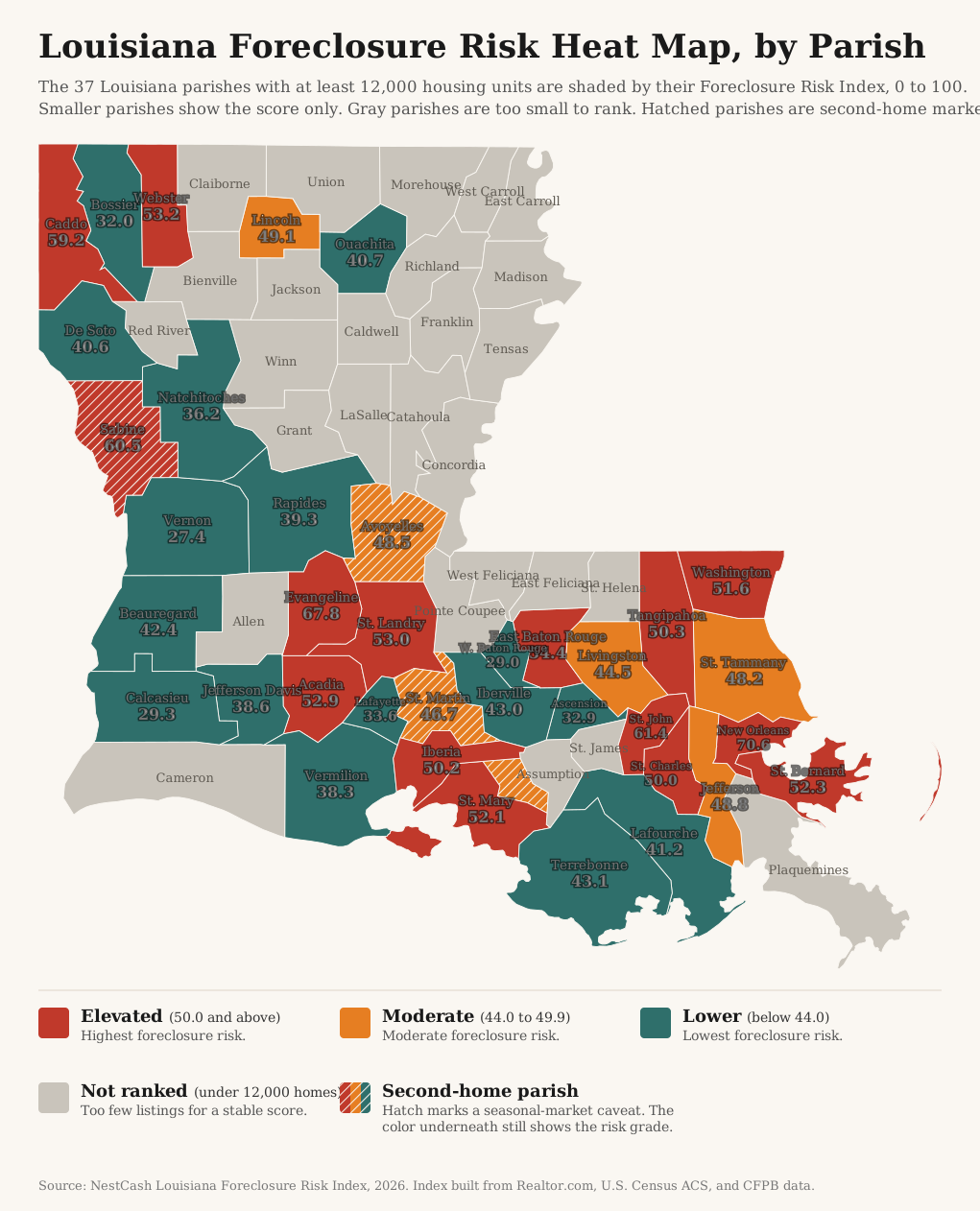
We built a parish-level Foreclosure Risk Index from four public datasets to see where that pressure sits. Unlike most states in this series, Louisiana’s pressure is not confined to small rural places. Eight parishes grade Elevated in every version of the index we tested, and they include all three of the state’s largest metro cores: Orleans Parish, home to New Orleans, which ranks first; East Baton Rouge Parish, home to Baton Rouge; and Caddo Parish, home to Shreveport. The other five are Evangeline, St. John the Baptist, Webster, St. Bernard, and Tangipahoa. The lowest-scoring parishes are in the southwest and the military country of west-central Louisiana: Vernon, Calcasieu, and Bossier.
We score each parish from 0 to 100 by blending four public signals, each weighted by how directly it bears on a mortgaged homeowner: market softness (35 percent), mortgage cost burden (30 percent), 90-day mortgage delinquency (20 percent), and unemployment (15 percent). Each signal is min-max normalized within Louisiana, so the score ranks parishes against one another in the state, not against a national or absolute standard. A parish grades Elevated at 50 or above, Moderate from 44 to 49.9, and Lower below 44. One rule keeps the ranking honest: we rank the 37 parishes with at least 12,000 housing units. Louisiana has 64 parishes, and the other 27 have too few homes for sale to score a market reliably, so they stay in the data but are not ranked. The 37 ranked parishes hold 90.9 percent of the state’s homes. Because some of Louisiana’s results lean on inputs that need care, we tested the index five different ways and report which findings hold in all of them. The full weighting, the normalization, and the limits of the data are spelled out in the methodology section below.
Key findings
- Louisiana has the most seriously delinquent mortgages in the country. At the end of 2025, 2.1 percent of the state’s mortgages were 90 or more days past due, the highest rate of any state and more than double the national 0.9 percent. Mississippi was second at 1.8 percent. Louisiana’s rate has risen from 1.2 percent at the end of 2023 (CFPB).
- And its foreclosures take the longest. Homes completing foreclosure in the second quarter of 2026 had been in the process an average of 3,491 days, more than six times the national average. Louisiana has had the longest timeline in the nation in every year-end report since 2023 (ATTOM Data Solutions).
- New Orleans tops the index. Orleans Parish scores 70.6, ranks first in four of the five versions of the index we ran, and has the heaviest housing cost burden in the state, 40.0 percent, with a 2.6 percent delinquency rate.
- All three big metros hold up in every test. Orleans, East Baton Rouge (54.4), and Caddo (59.2) grade Elevated in all five versions, along with Evangeline, St. John the Baptist, Webster, St. Bernard, and Tangipahoa parishes.
- Filing counts understate the strain. Louisiana ranks only 22nd by foreclosure filing rate. With cases taking nearly a decade on average to finish, filings capture only part of the pressure that delinquency and negative equity show.
Methodology
Three limits to read first
We state these before the method because they shape how the Louisiana results should be read.
Delinquency data for 10 of 37 ranked parishes. The CFPB publishes a parish’s 90-day delinquency rate only when the parish has enough mortgages in its sample. In Louisiana, 10 of the 37 ranked parishes qualify, including every large metro parish. The other 27 carry the statewide rate of 2.1 percent, which is itself the highest state rate in the country. Because so many parishes share that substitute value, delinquency separates the metro parishes from one another more than it separates rural ones. The metro results at the top of the index, Orleans, Caddo, and East Baton Rouge, all rest on published rates of their own.
Second-home parishes. Median days on market is half of the market-softness input, and in Louisiana’s lake and camp country it is inflated by seasonal listings. We flag parishes where homes held for seasonal, recreational, or occasional use are 5 percent or more of housing, the cutoff we use across this series. Statewide, 2.2 percent of Louisiana’s homes fall in that category. Three ranked parishes clear the line: Sabine (20.4 percent, around Toledo Bend Reservoir), St. Martin (6.3 percent), and Avoyelles (5.2 percent). Orleans, at 4.3 percent, is the next parish below the line and is not flagged. Sabine ranks fourth on the standard index but falls to Moderate when market softness is measured by price cuts alone, so we do not count it among the robust findings.
Unemployment that has already moved. The Census unemployment figure is a five-year estimate covering 2020 through 2024, a window that includes the pandemic shutdowns. Current parish rates over the latest 12 months are lower almost everywhere in Louisiana, St. John the Baptist’s for example falls from 10.9 to 5.2 percent. Every parish in the robust group stays Elevated when the current rates are used.
We kept the standard formula anyway. Changing the method state by state would break the comparability that makes the series useful, and disclosing where the result is fragile is more useful to readers than tuning it away.
Data and sources
We built the index entirely from public and openly licensed data, and we cite each source at the point of use. Market conditions come from Realtor.com Economic Research (parish listing data through September 2026). Housing tenure, mortgage status, cost burden, seasonal homes, parish housing counts, and unemployment come from the U.S. Census Bureau’s American Community Survey five-year estimates (2020 to 2024). Mortgage delinquency comes from the Consumer Financial Protection Bureau’s Mortgage Performance Trends (latest data December 2025). Current parish unemployment for the sensitivity test comes from the Bureau of Labor Statistics’ Local Area Unemployment Statistics. Statewide filing counts, national ranks, timelines, and negative equity come from ATTOM Data Solutions’ published reports. Every dataset we used is free and publicly available.
Building the index
The Louisiana Foreclosure Risk Index uses the same formula as every state in this series, a weighted blend of four signals, each chosen because it precedes or predicts foreclosure among homeowners who carry a mortgage:
35%
The share of active listings with a price cut and the median days a home sits on the market. A soft market matters because a homeowner in trouble who cannot sell quickly has fewer ways to avoid foreclosure. See the note on second-home parishes above.
30%
The share of owners with a mortgage who spend more than 30 percent of household income on housing. This is direct payment stress on the exact population that can be foreclosed on.
20%
The 90-day-or-more delinquency rate, the clearest early warning that foreclosures are coming. Published for 10 of Louisiana’s 37 ranked parishes. See the note above.
15%
A secondary driver. We hold its weight down deliberately, because unemployment also captures renters and therefore dilutes a signal meant to describe homeowners.
We normalized each signal across the 37 ranked parishes on a 0-to-1 scale, where 0 is the lowest value in that set and 1 is the highest, then applied the weights above and multiplied by 100. The result is a relative score: it ranks Louisiana parishes against one another, not against a national or absolute standard. We then graded each parish by its score, Elevated for 50.0 or above, Moderate for 44.0 to 49.9, and Lower for anything below 44.0. Fifteen parishes land in the Elevated tier, six in Moderate, and 16 in Lower. The Elevated parishes hold 38.7 percent of the state’s homes.
To test how much the results depend on any one input, we scored the parishes five ways: the standard index; the standard index with current Bureau of Labor Statistics unemployment, the 12 published months from August 2025 through August 2026, in place of the Census five-year estimate; the index with delinquency removed and its weight spread proportionally across the other three signals; the index with market softness measured by price cuts alone; and price cuts alone combined with current BLS unemployment. When we call a finding robust in this report, it holds in all five.
Other limitations
The index is relative. A Lower grade means lower measured risk than other Louisiana parishes, and in a state with the country’s highest delinquency rate that distinction matters. It also measures leading pressure, not completed foreclosures or filings, so it will not match any single month’s filing counts. ATTOM named West Baton Rouge, Plaquemines, St. Bernard, and Union as the Louisiana parishes with the worst foreclosure filing rates in August 2026. St. Bernard grades Elevated in every version of our index. West Baton Rouge grades Lower, and Plaquemines and Union are below our 12,000-home floor. Parishes that tie at the published one-decimal score would share a rank. None do in this edition.
Findings
The index
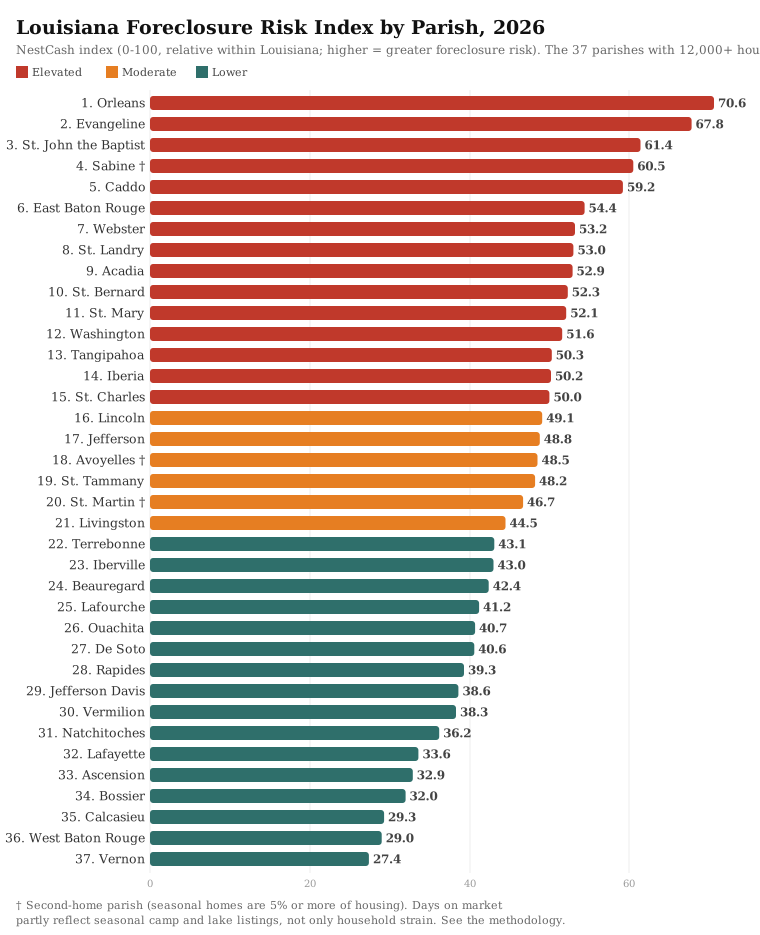
Ranked from most to least risk on the standard formula. Read the daggered second-home parishes with the limits above in mind.
New Orleans: the finding that holds
Orleans Parish scores 70.6, the highest in Louisiana, and it ranks first in four of the five versions of the index and second in the fifth. Its owners carry the heaviest housing cost burden in the state, 40.0 percent of mortgaged owners spending more than 30 percent of income on housing, and its 2.6 percent delinquency rate is tied with Caddo for the second highest published rate in Louisiana. Homes sat a median of 86 days on the market in September 2026. Its neighbors downriver point the same way: St. Bernard Parish (52.3) grades Elevated in every version, and ATTOM named it among the four Louisiana parishes with the worst filing rates in August 2026. Orleans also ranks fourth among 1,129 U.S. counties on our Vacant & Abandoned Property Index, where 10.7 percent of its homes sit vacant and off the market.
The rest of metro New Orleans grades Moderate. Jefferson Parish (48.8) and St. Tammany Parish (48.2) have delinquency rates of 2.0 and 2.2 percent, high by national standards but lower than Orleans, and cost burdens near 30 percent. St. John the Baptist Parish (61.4), upriver, grades Elevated in every version, with the highest five-year unemployment estimate in the state, 10.9 percent.
Baton Rouge and Shreveport
East Baton Rouge Parish, the largest in Louisiana with 206,591 homes, scores 54.4 and grades Elevated in every version of the index. Its 2.3 percent delinquency rate is the fourth highest of the parishes with published rates. Baton Rouge also has the highest share of seriously underwater homes of any U.S. metro, 11.9 percent in the first quarter of 2026, with New Orleans third at 10.2 percent (ATTOM Data Solutions). Tangipahoa Parish (50.3), home to Hammond, is also robust, with a 26.0 percent price-cut share, among the heaviest in the state.
In the northwest, Caddo Parish, home to Shreveport, ranks fifth at 59.2 and grades Elevated in all five versions, on a 2.6 percent delinquency rate and slow sales, a median of 80 days on the market. Webster Parish (53.2), east of Shreveport, is robust as well. Bossier Parish, across the Red River from Shreveport, is one of the lowest-scoring parishes in the state at 32.0, with a 1.7 percent delinquency rate.
Acadiana and the rural parishes
Evangeline Parish ranks second at 67.8 and grades Elevated in every version, on the second-highest cost burden in Louisiana, 39.3 percent. It does not have a published delinquency rate of its own, and without delinquency in the score it ranks first. St. Landry (53.0), St. Mary (52.1), and Iberia (50.2) also grade Elevated, though each falls below the line in one of the five versions. St. Mary, Iberia, and Washington parishes (51.6) are among the 25 U.S. counties with the most vacant and abandoned housing on our vacancy index. Acadia Parish (52.9) has the slowest market in the state, a median of 112 days, and falls to Lower when market softness is measured by price cuts alone.
Livingston Parish is the exception that shows how the index works. Its 2.9 percent delinquency rate is the highest published rate in Louisiana, but it grades Moderate at 44.5, because its homes sell relatively quickly and its owners carry a lower cost burden, 22.4 percent. Without delinquency in the score it falls to 30.6.
The lowest-scoring parishes
Vernon Parish (27.4), home to Fort Johnson, is the lowest-scoring parish in the state, followed by West Baton Rouge (29.0), Calcasieu (29.3), Bossier (32.0), Ascension (32.9), and Lafayette (33.6). Calcasieu, home to Lake Charles, has the lowest published delinquency rate in Louisiana, 1.5 percent, and Lafayette and Bossier share the next lowest, 1.7 percent. Even those rates are well above the national figure of 0.9 percent, a reminder that a Lower grade is relative.
How long a Louisiana foreclosure takes
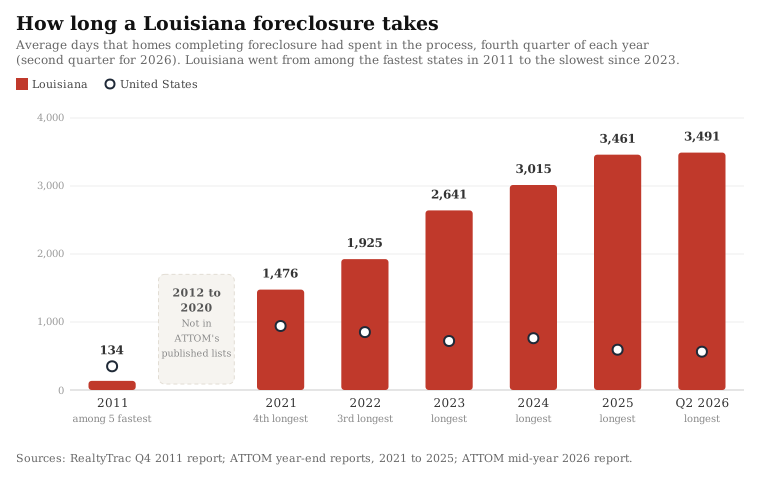
Louisiana was never a crisis state by filing rate. In 2009, at the height of the last foreclosure wave, it ranked 39th among the states, with 0.63 percent of homes receiving a filing (RealtyTrac). In the fourth quarter of 2011 its foreclosures were among the fastest in the country, an average of 134 days from start to finish.
That has reversed. By the fourth quarter of 2021 the average Louisiana foreclosure completed that quarter had taken 1,476 days, the fourth longest in the country. It reached the longest in the nation in 2023, at 2,641 days, and has held that position since: 3,015 days at the end of 2024, 3,461 days at the end of 2025, and 3,491 days in the second quarter of 2026, against a national average of 563 days (ATTOM Data Solutions). Louisiana’s figures for 2012 through 2020 do not appear in the published reports, so the chart shows those years as a gap. New York, the subject of our New York index, has the third-longest timeline, 2,007 days. Neighboring Alabama is the opposite case: it had some of the shortest timelines in the country in the fourth quarters of 2012, 2013, and 2016, as our Alabama Foreclosure Risk Index shows.
The statute does not explain the length. Most Louisiana foreclosures use executory process, which allows a seizure and sale without a prior lawsuit and judgment, and the first sheriff’s sale can be scheduled 60 days after the court’s order. The averages are an ATTOM measure of homes that completed foreclosure in a given quarter, so a group of very old cases finishing at once can pull them up, and we found no official explanation for the rise. What the numbers do show is that Louisiana homeowners who fall behind can stay in their homes, and in limbo, for a very long time, which is one more reason filing counts understate the pressure the delinquency data reveals.
If you are a Louisiana homeowner facing foreclosure
This report is a market analysis, not legal advice, but the data points to a few things worth knowing. Louisiana foreclosures go through the courts, and most use executory process, which lets a lender seize and sell a home “without previous citation and judgment” when the mortgage includes a confession of judgment (Code of Civil Procedure art. 2631). The sheriff must serve you a written notice of seizure, and for a home that notice must include information about housing counseling (art. 2721). The first sheriff’s sale cannot be scheduled earlier than 60 days after the court’s order (R.S. 13:3852), and a home sale must be advertised twice, the first time at least 30 days before the sale (R.S. 43:203).
Unless you waived it in the mortgage, the home must be appraised, and at the first sale it cannot sell for less than two-thirds of the appraised value (art. 2336). If the lender sells without an appraisal and the sale does not cover the debt, the remaining debt is extinguished, and that protection cannot be waived (R.S. 13:4106 and 13:4107). To challenge the foreclosure, a homeowner can seek an injunction (art. 2751), and an appeal that suspends the sale must be filed within 15 days of the notice of seizure (art. 2642). Louisiana does not give homeowners a right to redeem the home after the sale (Nolo).
Free help is available. A HUD-approved housing counselor can review your options at no cost. Call (800) 569-4287 to find one near you (HUD), or use the CFPB’s housing counselor search. Southeast Louisiana Legal Services provides free civil legal help at 1-844-244-7871 (SLLS), and Acadiana Legal Service Corporation, which serves 42 parishes in south, central, and north Louisiana, at 1-866-ASK-ALSC (ALSC). The Louisiana Housing Corporation keeps a guide to foreclosure prevention with more local referrals, and the Louisiana Office of Financial Institutions, which regulates residential mortgage lenders, can be reached at (225) 925-4660 (OFI). Be wary of anyone who charges up-front fees to stop a foreclosure or asks you to sign over the deed to your home.
The full data
All 37 ranked parishes, from highest to lowest Foreclosure Risk Index. An asterisk on the delinquency rate marks a parish where the Louisiana statewide rate was substituted because its own rate is not separately reported. A dagger marks a second-home parish, where seasonal homes are 5 percent or more of housing. Unemployment is the five-year Census estimate used in the index.
| Rank | Parish | FRI | Grade | Price cuts | Median DOM | Cost burden | 90+ delinq | Unemployment |
|---|---|---|---|---|---|---|---|---|
| 1 | Orleans | 70.6 | Elevated | 17.3% | 86 | 40.0% | 2.6% | 7.5% |
| 2 | Evangeline | 67.8 | Elevated | 17.3% | 87 | 39.3% | 2.1*% | 9.8% |
| 3 | St. John the Baptist | 61.4 | Elevated | 17.3% | 62 | 37.2% | 2.1*% | 10.9% |
| 4 | Sabine † | 60.5 | Elevated | 12.2% | 110 | 37.4% | 2.1*% | 6.6% |
| 5 | Caddo | 59.2 | Elevated | 18.8% | 80 | 27.8% | 2.6% | 8.7% |
| 6 | East Baton Rouge | 54.4 | Elevated | 21.2% | 75 | 28.6% | 2.3% | 7.7% |
| 7 | Webster | 53.2 | Elevated | 17.8% | 71 | 38.4% | 2.1*% | 5.1% |
| 8 | St. Landry | 53.0 | Elevated | 18.8% | 93 | 30.2% | 2.1*% | 6.3% |
| 9 | Acadia | 52.9 | Elevated | 15.6% | 112 | 25.6% | 2.1*% | 7.7% |
| 10 | St. Bernard | 52.3 | Elevated | 21.1% | 85 | 27.3% | 2.1*% | 7.6% |
| 11 | St. Mary | 52.1 | Elevated | 22.5% | 106 | 25.5% | 2.1*% | 5.4% |
| 12 | Washington | 51.6 | Elevated | 16.9% | 65 | 29.9% | 2.1*% | 9.9% |
| 13 | Tangipahoa | 50.3 | Elevated | 26.0% | 74 | 27.4% | 2.1*% | 6.0% |
| 14 | Iberia | 50.2 | Elevated | 22.8% | 70 | 28.1% | 2.1*% | 7.3% |
| 15 | St. Charles | 50.0 | Elevated | 24.1% | 73 | 27.4% | 2.1*% | 6.7% |
| 16 | Lincoln | 49.1 | Moderate | 16.9% | 105 | 30.2% | 2.1*% | 3.8% |
| 17 | Jefferson | 48.8 | Moderate | 20.3% | 75 | 30.9% | 2.0% | 6.2% |
| 18 | Avoyelles † | 48.5 | Moderate | 18.2% | 65 | 31.9% | 2.1*% | 6.9% |
| 19 | St. Tammany | 48.2 | Moderate | 22.1% | 71 | 30.1% | 2.2% | 4.8% |
| 20 | St. Martin † | 46.7 | Moderate | 31.0% | 93 | 20.0% | 2.1*% | 4.0% |
| 21 | Livingston | 44.5 | Moderate | 19.3% | 65 | 22.4% | 2.9% | 4.2% |
| 22 | Terrebonne | 43.1 | Lower | 12.5% | 94 | 28.8% | 2.1*% | 4.7% |
| 23 | Iberville | 43.0 | Lower | 13.6% | 76 | 29.4% | 2.1*% | 6.1% |
| 24 | Beauregard | 42.4 | Lower | 15.9% | 85 | 23.8% | 2.1*% | 6.8% |
| 25 | Lafourche | 41.2 | Lower | 15.8% | 101 | 24.1% | 2.1*% | 4.2% |
| 26 | Ouachita | 40.7 | Lower | 17.4% | 53 | 29.0% | 2.1*% | 6.5% |
| 27 | De Soto | 40.6 | Lower | 13.3% | 67 | 29.7% | 2.1*% | 6.0% |
| 28 | Rapides | 39.3 | Lower | 19.5% | 72 | 24.5% | 2.1*% | 5.1% |
| 29 | Jefferson Davis | 38.6 | Lower | 17.5% | 97 | 20.5% | 2.1*% | 4.7% |
| 30 | Vermilion | 38.3 | Lower | 13.3% | 88 | 24.4% | 2.1*% | 5.2% |
| 31 | Natchitoches | 36.2 | Lower | 17.1% | 73 | 22.4% | 2.1*% | 5.6% |
| 32 | Lafayette | 33.6 | Lower | 20.6% | 77 | 22.6% | 1.7% | 5.1% |
| 33 | Ascension | 32.9 | Lower | 18.9% | 73 | 21.6% | 2.0% | 4.4% |
| 34 | Bossier | 32.0 | Lower | 17.5% | 63 | 25.1% | 1.7% | 5.9% |
| 35 | Calcasieu | 29.3 | Lower | 16.1% | 84 | 22.5% | 1.5% | 5.4% |
| 36 | West Baton Rouge | 29.0 | Lower | 26.4% | 43 | 13.3% | 2.1*% | 7.0% |
| 37 | Vernon | 27.4 | Lower | 9.8% | 81 | 17.9% | 2.1*% | 5.7% |
Twenty-seven parishes are not ranked because they fall below the 12,000-housing-unit floor: Allen, Assumption, Bienville, Caldwell, Cameron, Catahoula, Claiborne, Concordia, East Carroll, East Feliciana, Franklin, Grant, Jackson, LaSalle, Madison, Morehouse, Plaquemines, Pointe Coupee, Red River, Richland, St. Helena, St. James, Tensas, Union, West Carroll, West Feliciana, and Winn.
What we will watch
We plan to update this index quarterly, beginning with the first quarter of 2027. Three things will tell us where Louisiana goes from here: whether the statewide delinquency rate, already the highest in the country, keeps rising; whether the state’s foreclosure timeline finally begins to shorten, which would turn today’s long-delinquent loans into filings and sales; and whether the metro parishes of New Orleans, Baton Rouge, and Shreveport, all Elevated today, stay at the top of the index.
Sources and data
- Foreclosure activity, timelines, and negative equity. ATTOM Data Solutions, 2026 Mid-Year U.S. Foreclosure Market Report, U.S. Foreclosure Rates by State, August 2026, Q1 2026 Home Equity and Underwater Report, and the RealtyTrac and ATTOM year-end U.S. foreclosure market reports for 2011 and 2021 through 2025, including ATTOM’s 2025 report. Used for statewide filing counts, national ranks, average days to complete a foreclosure, seriously underwater shares, and the parishes with the worst August filing rates.
- Historical filing rate. RealtyTrac, 2009 Year-End Foreclosure Market Report (via the Financial Crisis Inquiry Commission archive). Used for Louisiana’s 2009 rate and rank.
- Housing market softness. Realtor.com Economic Research, county inventory core metrics through September 2026. Used for the price-cut share, median days on market, and active listing counts.
- Housing, mortgage status, cost burden, seasonal homes, and unemployment. U.S. Census Bureau, American Community Survey five-year estimates, 2020 to 2024.
- Current unemployment. U.S. Bureau of Labor Statistics, Local Area Unemployment Statistics, the 12 published months from August 2025 through August 2026 (BLS published no October 2025 figures). Used only for the sensitivity test.
- Mortgage delinquency. CFPB Mortgage Performance Trends, state and county data through December 2025. Used for the 90-or-more day delinquency rates and the national and state comparisons.
- Foreclosure process. Louisiana Code of Civil Procedure articles 2336, 2631, 2642, 2721, and 2751, and Revised Statutes 13:3852, 13:4106, 13:4107, and 43:203. Help resources from HUD, SLLS, ALSC, the Louisiana Housing Corporation, and the Office of Financial Institutions.
About NestCash
NestCash buys houses for cash in twelve states and publishes original housing and distressed-property research across U.S. markets. Our original housing research helps homeowners, buyers, and investors understand local market conditions. This report may be cited and its charts embedded with attribution to NestCash.

John is the Founder of NestCash and a leading voice in real estate investing and housing market strategy. With experience across 12 states, he helps buyers, sellers, and investors make smarter decisions using real-world insight and market data.