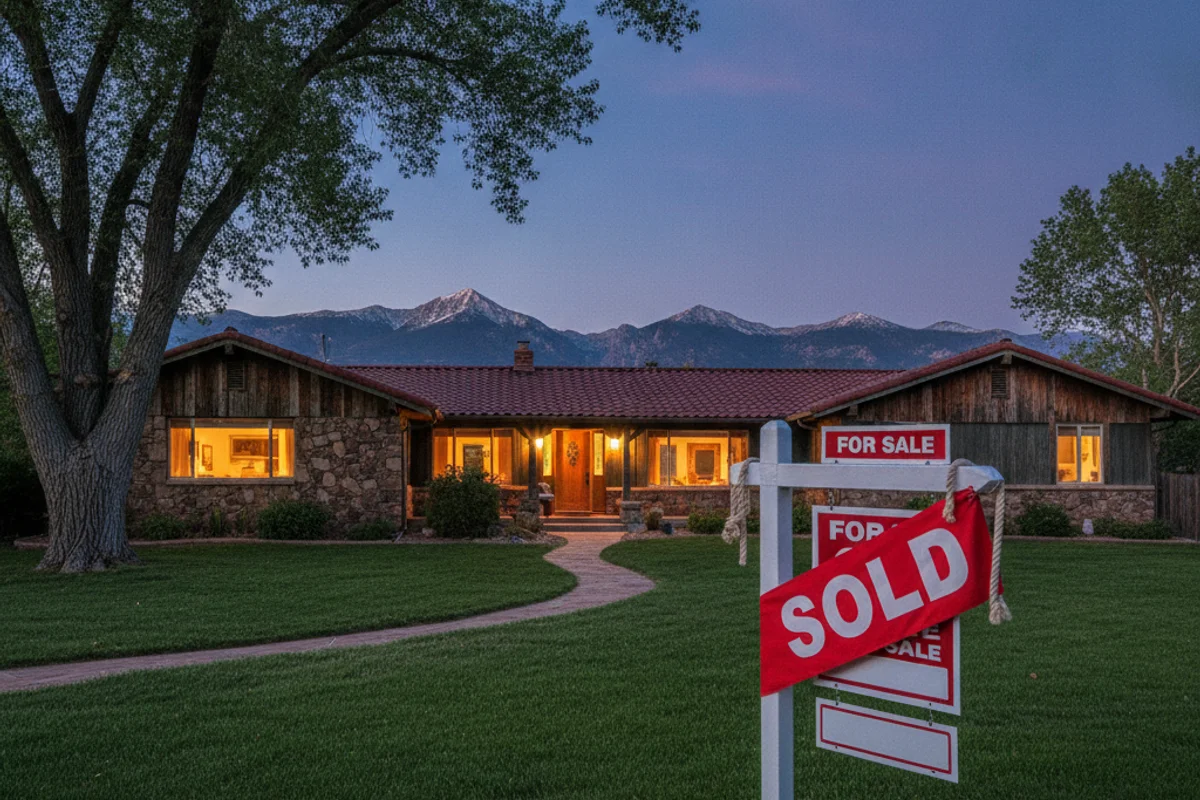
Sell House During Divorce In Colorado Springs: Get Your Offer in 24 Hours
Need to sell your house during divorce in Colorado Springs? Learn how cash buyers offer speed and simplicity with fair splits, zero repairs, and closing in 10-14 days.

Senior Contributor, NestCash··13 min read

You do not have to finish the divorce before you can sell your house during divorce in Colorado Springs. That misconception keeps couples stuck paying for a shared home neither of them lives in anymore. The truth is simpler: Colorado law allows you to sell marital property while the divorce is in process, as long as both parties agree or the court approves. The home on the deed in Broadmoor or Old North End doesn’t need to sit empty accumulating costs while attorneys negotiate every other detail.
Here’s the thing. Divorce proceedings in Colorado typically take 6-12 months from filing to finalization. That’s six months of mortgage payments, property taxes, insurance, and utilities on a house that represents a painful chapter you’re both trying to close. At Colorado Springs’ median home price of $441,000, you’re looking at roughly $2,800 monthly in mortgage payments alone. That number doesn’t include the $450 monthly property tax bill or the $150 insurance premium.
The good news is that selling quickly reduces both financial drain and interpersonal conflict. When you work with Colorado Springs cash home buyers, you eliminate the 66-day market wait, the repair negotiations, the showing appointments you need to coordinate, and the uncertainty about when (or if) a buyer will follow through. A fast sale means a clean division of proceeds and the ability to move forward with your separate lives.
Myth vs. Reality: Selling a Home in Colorado Springs During Divorce
The biggest myth divorcing homeowners believe is that the house has to sit on the market for months to get a fair price. Let’s look at the actual numbers.
Traditional listings in Colorado Springs currently average 66 days on market, according to recent local market data. Add another 30-45 days for buyer financing, inspections, appraisals, and closing. You’re at three to four months minimum. During that time, you’re both still financially tied to the property. You’re coordinating showing schedules. You’re debating whether to fix the HVAC system or repaint the bedrooms.
Cash sales work differently. Most Colorado Springs cash offers close in 10-14 days. You skip the repairs. You avoid the agent commission (typically 6% of sale price, or $26,460 on that median $441,000 home). You eliminate the risk that a buyer’s financing falls through at the last minute, sending you back to square one.
The reality is that speed has a price. Cash offers typically come in at 70-85% of retail market value. On a $441,000 home, that’s $308,700 to $374,850. But when you subtract the $26,460 in realtor fees, the $8,000 average in seller concessions and repairs, and three extra months of mortgage payments at $2,800 each, the traditional sale nets you roughly $397,740. The cash sale at 80% of value nets you $352,800 with zero hassle and immediate closure.
For many divorcing couples, the $45,000 difference is worth the certainty, speed, and finality. You can read more detailed cost comparisons in our guide on cash offer vs listing with realtor in Colorado Springs.
Another myth: you need total agreement on every aspect of the sale before you can start. In practice, Colorado courts can order the sale of marital property if one spouse is being unreasonable or blocking progress. If your soon-to-be ex won’t cooperate on listing the house, your attorney can petition the court for a sale order.
For a complete guide, read our resource on selling during divorce in Colorado Springs.

Get Your Free Cash Offer Today
No fees. No repairs. Close in as little as 7 days.
Related Video
The Colorado Timeline: When Can You Actually Sell?
Colorado divorce law operates on specific timelines that affect when and how you can sell a house in Colorado. Understanding these timelines helps you plan.
Colorado requires a 91-day waiting period from the date divorce papers are served before the divorce can be finalized. During those 91 days, you can absolutely list and sell the home if both spouses consent in writing. Many couples do exactly that to simplify the asset division conversation.
If one spouse objects to the sale, the other can file a motion asking the court to order the sale. The judge will schedule a hearing, review the arguments, and issue an order. This process typically adds 30-60 days but removes the roadblock.
Colorado follows equitable distribution for marital property, meaning the judge divides assets fairly rather than automatically splitting everything 50-50. Equitable distribution considers factors like each spouse’s income, non-financial contributions to the marriage, and how long you were married. The court looks at your full financial picture, not just the house.
In practice, most Colorado judges split home equity 50-50 unless there’s a compelling reason to deviate. If one spouse used separate property (like an inheritance) as the down payment, that spouse might receive credit for that amount before the remaining equity is divided. If one spouse committed financial waste (like gambling away marital funds), the judge might award the other spouse a larger share to compensate.
The Colorado property disclosure law applies during divorce sales just like any other transaction. Colorado requires sellers to complete a seller’s property disclosure form disclosing known material defects. Both spouses must sign this disclosure if both names are on the deed.
Here’s where court orders matter. If your divorce decree or temporary orders specify how the home should be sold (by a certain date, at a minimum price, with a specific agent), you must follow those orders. Violating a court order creates legal consequences. If the orders don’t specify these details, you have more flexibility.
How to Calculate Your True Equity in a Colorado Springs Divorce Sale
Typical closing costs and deductions:
- 6% realtor commission: $26,100
- Title insurance and closing costs: $2,500, $4,000
- Seller concessions (repairs, buyer closing cost help): $5,000, $10,000
- Property taxes prorated to closing: varies
- Outstanding HOA fees: varies by neighborhood
The IRS allows married couples filing jointly to exclude up to $500,000 in capital gains from the sale of a primary residence, or $250,000 if filing separately. Most Colorado Springs divorcing couples won’t hit these thresholds. If you bought your home for $320,000 and sell for $441,000, your gain is $121,000, well below the exclusion limits. The IRS guidance on home sale tax implications provides more detail.

Find Out What Your Home Is Worth
Get a no-obligation cash offer in 24 hours.
Joint Mortgage Strategies for Colorado Springs Divorcing Couples
The divorce decree says your ex is responsible for the mortgage. Six months later, your ex stops paying. The bank calls you because your name is still on the loan. This scenario plays out constantly.
Here’s the brutal truth: divorce decrees bind the divorcing spouses, but they don’t bind third parties like mortgage lenders. When both names are on the mortgage, both parties remain legally liable to the lender regardless of what the divorce decree says. If one spouse defaults, the lender pursues both, and both credit scores suffer.
You have four main options for handling joint mortgages in Colorado Springs divorce:
Option 1: Sell the house and pay off the mortgage. This is the cleanest break. Both names come off the loan. The debt is satisfied. Each spouse receives their share of proceeds and moves on. No future liability.
Option 2: One spouse refinances and removes the other from the loan. This requires the remaining spouse to qualify for a new mortgage based solely on their income and credit. In Colorado Springs, where the median home price is $441,000, the remaining spouse needs income of roughly $95,000 annually to qualify for the loan alone (assuming minimal other debt). Many divorcing spouses don’t meet this threshold.
Option 3: One spouse assumes the existing loan. Some lenders allow loan assumptions where one borrower is released and the other takes full responsibility. This is uncommon with conventional mortgages but sometimes possible with FHA or VA loans. You’ll need lender approval.
Option 4: Keep both names on the loan and cross your fingers. This is the riskiest option. One spouse moves out, the other stays and makes payments. The spouse who moved out remains liable if payments stop. Their credit is tied to their ex’s payment behavior. Their debt-to-income ratio includes this mortgage, making it harder to qualify for a new home loan. We don’t recommend this approach.
Selling to cash home buyers solves the mortgage problem immediately. You get your cash offer within 24-48 hours, close in 10-14 days, and use the proceeds to pay off the loan. Both spouses walk away with no ongoing liability.
If you’re in a neighborhood like Briargate, Rockrimmon, or the Powers corridor, your home likely has solid equity given Colorado Springs’ stable market. That equity can fund your fresh start.
Market Timing: Is Colorado Springs a Good Time to Sell?
Colorado Springs real estate runs on patterns you need to understand before listing.
The market is currently stable with moderate inventory. That means it’s neither a screaming seller’s market (where multiple offers are guaranteed) nor a buyer’s market (where prices are dropping). Homes are selling, but they take 66 days on average. Compare that to Denver’s market, where some inventory-starved areas see homes sell in half that time.
Colorado Springs has unique seasonal factors. Spring and early summer (April through July) bring the strongest buyer activity. Military families transferring to Fort Carson and Peterson Space Force Base typically move during summer. Families with school-age kids want to close before the new school year.
Fall and winter slow down. Buyers who are serious remain active, but the casual lookers disappear. Homes that hit the market in November often sit until February unless they’re priced aggressively. If your divorce timeline allows, listing in spring maximizes your buyer pool. If you need to sell now regardless of season, cash buyers operate year-round without the seasonal slowdown.
The current 23% cash sale percentage in Colorado Springs indicates healthy investor and cash buyer activity. Nearly one in four homes sells to a cash buyer. This isn’t unusual. Investors recognize Colorado Springs’ growth trajectory, fueled by military presence, tech sector expansion, and migration from pricier Front Range cities.
Location within Colorado Springs matters enormously. A home in Old Colorado City will attract different buyers than a property in the Chapel Hills area. Broadmoor homes command premium prices but represent a smaller buyer pool. Developments near Powers Boulevard appeal to families wanting newer construction and good schools.
If you’re going the traditional listing route, price matters more than ever in a stable market. Overpriced homes sit for months and eventually sell below market value after multiple price cuts. Your agent should provide comps (comparable sales) from your specific neighborhood, not just city-wide averages.
Cash buyers evaluate differently. They’re looking at repair costs, rental potential, and quick turnaround. Your home’s condition matters less. The 1980s kitchen and dated bathrooms that would scare off traditional buyers don’t faze cash buyers who plan to update anyway.
Getting from Offer to Closing in Colorado: What to Expect
Let’s walk through both paths so you understand what you’re signing up for.
Traditional sale timeline: You list the home, probably after spending $3,000, $8,000 on pre-listing repairs and staging. The home sits on market for 66 days on average. During this time, you coordinate showings (a nightmare when two divorcing spouses need to agree on timing), keep the house spotless, and answer buyer questions through your agent.
You receive an offer. The buyer wants a home inspection. The inspector finds issues. The buyer requests $6,000 in repairs or a price reduction. You and your ex debate who should pay and whether to negotiate. Finally you agree. The buyer’s appraisal comes in $5,000 low. More negotiation.
The buyer’s lender requests additional documentation. Their loan approval takes 30-45 days if everything goes smoothly. One day before closing, the lender needs one more document. You scramble to provide it. Finally, 100-120 days after listing, you close.
Cash sale timeline: You contact a quick home sale buyer in Colorado. They visit the property or do a virtual evaluation. Within 24-48 hours, you receive a written cash offer. There are no contingencies for financing, no inspection demands, and no appraisal requirements.
You and your spouse review the offer. If you accept, you choose a closing date. Most cash buyers can close in as little as 7 days or as long as 60 days, depending on your needs. The title company prepares documents. On closing day, you sign papers and receive funds. The entire process takes 10-14 days in most cases.
The contrast is stark. Three to four months versus two weeks. Constant coordination and conflict versus minimal interaction. Uncertain outcome versus guaranteed sale.
Colorado law requires you to complete the seller’s property disclosure regardless of buyer type. Be honest about known defects. Failing to disclose material issues can create legal liability even after closing.
Your divorce attorney should review the sale agreement before you sign. The proceeds distribution needs to match your divorce settlement or temporary court orders. If the decree specifies that one spouse receives the first $20,000 of proceeds before the remainder is split, make sure the closing instructions reflect that.
Title companies in Colorado Springs handle the paperwork, but you need to communicate the specific split instructions clearly. If both spouses can’t attend closing together, you’ll need to arrange separate signing appointments or grant power of attorney.
For couples whose divorce is contentious, having minimal interaction during the home sale is worth real money. Cash sales reduce the number of decisions you need to make jointly. There are no debates about which repair contractor to hire, no arguments about list price reductions, and no fights about showing availability.
We also work with homeowners in Aurora, Denver, Fort Collins, and Lakewood who face similar divorce situations. The process works the same regardless of which Front Range city you call home.
If you want to compare the full cost breakdown between cash and traditional sales, our article on cash offer vs listing with realtor in Denver shows the real math. The principles apply to Colorado Springs as well.
The bottom line: selling your house during divorce in Colorado Springs doesn’t have to drag on for months. You have options that prioritize speed, simplicity, and fairness. Cash buyers provide a legitimate path for couples who want to move forward quickly without the friction of traditional sales.
Colorado’s equitable distribution law means the court will ensure a fair split regardless of how you sell. The question isn’t whether you’ll each get your fair share. The question is how long you want the process to take and how much conflict you’re willing to endure to potentially net a bit more money.
For many divorcing Colorado Springs homeowners, the answer is clear. A fast sale means lower costs, less stress, and the ability to start the next chapter without being financially and emotionally anchored to a shared past. Whether you choose a traditional listing or a cash sale, the important thing is making a decision and moving forward. The house is just a house. Your future is what matters.
We also help homeowners in Colorado Springs dealing with foreclosure, selling as-is, and inherited property situations.

Ready to Sell? Let's Talk.
Get your cash offer now. No obligation, no hassle.

Lisa is a Senior Contributor at NestCash, writing expert content on real estate, homeownership, and market trends. She covers 12 states, with a focus on making real estate information practical, clear, and useful.