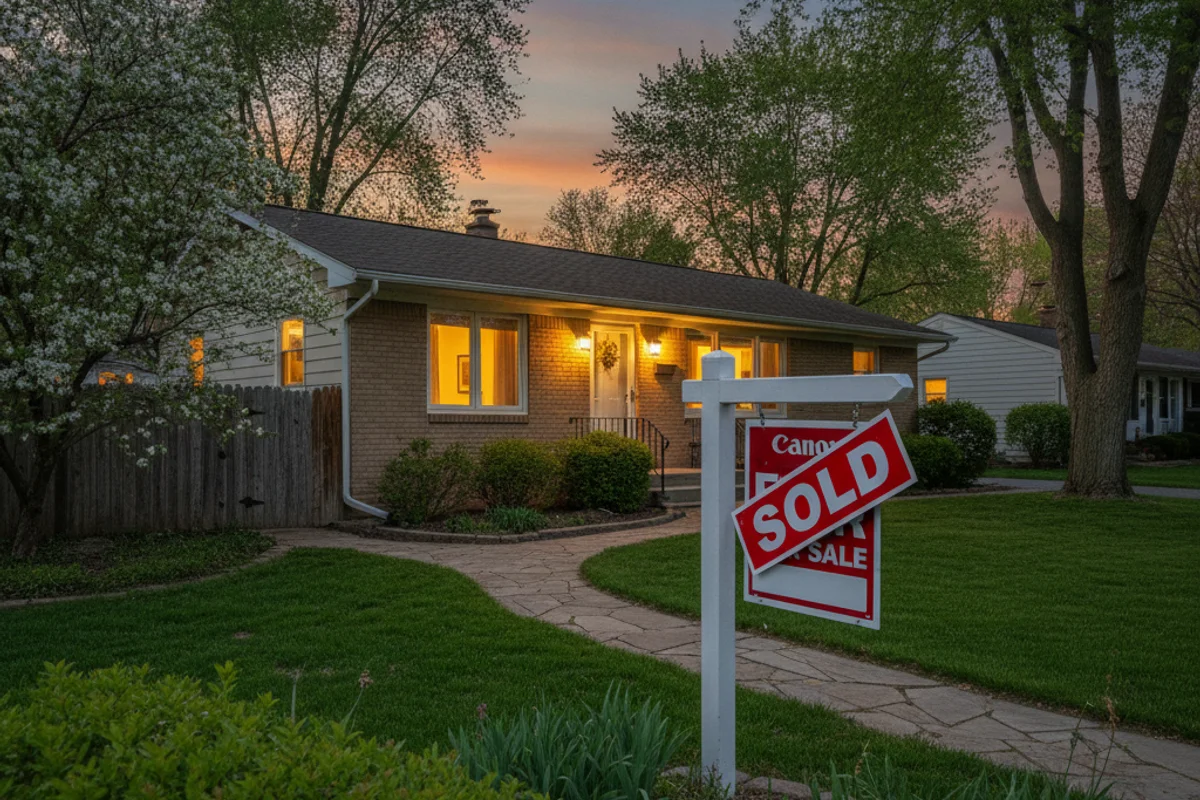
Sell House During Divorce In Naperville: No Repairs Required
Learn how Illinois equitable distribution affects your Naperville home sale during divorce. Get cash offers in 24 hours and split proceeds cleanly.

COO & Correspondent, NestCash··14 min read
Illinois law treats marital property under an equitable distribution framework, not a 50/50 split. That legal distinction matters enormously when you need to sell your house during divorce in Naperville, because the court has discretion to divide assets based on factors like income, contributions to the marriage, and future earning capacity. Unlike community property states where the home is automatically split evenly, Illinois judges evaluate what’s “fair” based on your specific circumstances. Understanding this framework changes how you should approach your home sale strategy.
The good news is that most divorcing couples can avoid letting a judge make these decisions by agreeing to sell a house in Illinois and divide the proceeds. The median home price in Naperville sits at $485,000, which represents significant equity for most couples. Getting that equity divided and deposited into separate accounts eliminates one of the biggest sources of ongoing conflict during divorce proceedings.
Here’s what makes Naperville different from other Illinois markets right now: inventory levels are moderate, homes spend an average of 35 days on market, and roughly 24% of sales involve cash buyers. That last number matters if you want to close quickly without repairs, inspections, or buyer financing falling through at the last minute.
Illinois Equitable Distribution Law and What It Means for Your Home
Illinois follows equitable distribution, not community property rules. Every asset acquired during your marriage is presumed marital property, including your Naperville home, even if only one spouse’s name appears on the deed.
The court considers multiple factors when dividing assets. Duration of the marriage carries significant weight. A couple married for 20 years in College Farm will see different distribution than newlyweds who bought in Downtown Naperville two years ago. Each spouse’s economic circumstances matter. If one spouse earns substantially more or has better earning potential, the court may allocate assets to balance future financial stability.
Contributions to marital property also factor into the equation. If one spouse used inheritance money for the down payment on your Ashbury home, that contribution might affect the final split. Similarly, if one spouse sacrificed career advancement to raise children while the other built a successful career at one of Naperville’s major employers like Edward-Elmhurst Health, the court considers these contributions.
The Illinois Marriage and Dissolution of Marriage Act (750 ILCS 5/503) gives judges broad discretion. This flexibility helps achieve fair outcomes in complex situations, but it also means you can’t predict with certainty what a judge will order. That uncertainty is exactly why many divorcing homeowners prefer to reach their own agreement and sell quickly.
When both spouses agree to sell, you control the timeline and the terms. You decide whether to list traditionally or accept a cash offer. You negotiate the equity split based on your situation rather than waiting months for a court date. You avoid legal fees that can easily reach thousands of dollars for contested property disputes.
The practical benefit of equitable distribution for motivated sellers is this: you have room to negotiate terms that work for both of you. Maybe one spouse gets a slightly larger share of the home proceeds while the other keeps the newer vehicle. Perhaps you split proceeds evenly but one spouse covers more of the closing costs. These compromises happen every day when couples prioritize moving forward over fighting in court.

Get Your Free Cash Offer Today
No fees. No repairs. Close in as little as 7 days.
Related Video
Your Joint Mortgage Options After Divorce in Naperville
The mortgage on your Springbrook home represents a shared liability that doesn’t disappear when your divorce decree is signed. Both names remain on that loan until you refinance or sell, regardless of what your divorce agreement says. This creates a critical problem many divorcing couples don’t anticipate.
Your divorce decree might assign the mortgage payment to your ex-spouse, but your lender isn’t bound by that court order. If your ex stops making payments, the lender will pursue both of you for the debt. Your credit score suffers. You might face collection actions or even foreclosure on a property you no longer live in and don’t control.
Here are your realistic options when both names appear on the mortgage:
- Sell the home and pay off the loan: Both spouses walk away clean with no ongoing liability. This is the simplest solution and eliminates future financial entanglement.
- One spouse refinances to remove the other: The spouse keeping the home must qualify for a new loan based solely on their income and credit. Many people can’t qualify alone, especially in Naperville’s price range.
- Keep both names on the loan temporarily: Risky and rarely advisable. You remain liable for the debt and need your ex’s cooperation for any future decisions about the property.
- One spouse assumes the loan: Some government-backed loans allow assumption, but the remaining spouse must meet lender qualifications. This option isn’t available for most conventional mortgages.
The refinancing route sounds straightforward until you run the numbers. If your Cress Creek home is worth $485,000 and you owe $320,000, the spouse keeping the house needs to qualify for a $320,000 mortgage plus enough cash to buy out the other spouse’s equity share. That’s a $320,000 loan and potentially $82,500 in cash for the buyout. Few people can manage both simultaneously, particularly if their income just dropped due to the divorce.
Cash home buyers in Naperville offer an alternative that sidesteps these complications entirely. You get a cash offer within 24 hours, close in as little as 10 days, and both spouses receive their share of the proceeds immediately. No refinancing. No credit checks. No wondering whether your ex will make next month’s mortgage payment.
The mortgage question also interacts with your timeline pressures. If you’re paying a mortgage on a house in Knoch Knolls that neither spouse lives in, every month costs you money. Property taxes in DuPage County aren’t cheap. Add insurance, utilities for an empty home, and lawn maintenance, and you’re spending thousands while building no equity.
These carrying costs make speed valuable. A traditional sale taking 35 days to find a buyer plus 30-45 days to close means two to three months of expenses. A quick home sale in Naperville eliminates most of that drain.
Three Ways to Divide Home Equity in an Illinois Divorce
Start with current market value. In Naperville’s stable market, you might use recent comparable sales in your specific neighborhood. A Highlands home won’t have the same value as a comparable-sized property in White Eagle. Online estimates from Zillow or Redfin provide starting points but can miss neighborhood-specific factors that affect value. Illinois property disclosure requirements mean you’ll need to reveal known defects, which might reduce your actual sale price below the automated estimate.
Tax implications of selling the marital home can affect your division strategy. The IRS allows married couples filing jointly to exclude up to $500,000 in capital gains from the sale of a primary residence. Single filers get a $250,000 exclusion. If you bought your Settlers Park home years ago for $280,000 and it’s now worth $485,000, you have $205,000 in potential gains, well under the married couple threshold. Timing your sale before or after the divorce finalization affects which exclusion applies.

Find Out What Your Home Is Worth
Get a no-obligation cash offer in 24 hours.
How Court Orders Affect Your Naperville Home Sale Timeline
Divorce court proceedings in DuPage County move at their own pace, which might not align with your need to sell quickly. Understanding how court orders interact with your sale timeline helps you plan realistically.
Some divorce decrees include specific orders about the marital home. The court might order the house sold and proceeds divided. It might award the home to one spouse with a buyout obligation to the other. It might allow one spouse to remain in the home until a triggering event like a child graduating high school.
Homeowners in Joliet face similar divorce sale challenges, and the legal framework applies the same across DuPage and Will counties. If your decree orders a sale, you have clear authority to move forward. Both spouses must cooperate with the sale process. Refusing to sign documents or allow showings could constitute contempt of court. This court backing actually smooths the sale process because neither spouse can block the transaction.
If your decree doesn’t specifically address the home, you need both spouses to agree on the sale. Both names on the deed mean both signatures are required to transfer ownership. One uncooperative spouse can prevent the sale until you return to court for a modified order.
The timing challenge hits hardest when you need to sell before the divorce is final. Many couples realize during the divorce process that keeping the house doesn’t make financial sense for either of them. Monthly carrying costs on a Maplebrook home might exceed what either spouse can comfortably afford alone. The smartest financial move is selling quickly, but you can’t complete a sale without both spouses’ cooperation.
Getting both parties to agree on a sale strategy becomes easier when you choose a fast, simple approach. Traditional listings require decisions about list price, which realtor to use, what repairs to make, how to handle showings, and whether to accept any given offer. Each decision point creates opportunities for conflict. Cash sales streamline decisions. You request an offer, review it together, and decide yes or no. The simplicity reduces friction.
Court orders can also affect your ability to accept certain offers or terms. If the court ordered the home sold at fair market value, you might need court approval to accept a cash offer that’s below a traditional listing price, even if the net proceeds end up similar after accounting for repairs and carrying costs. Working with an attorney familiar with DuPage County divorce proceedings helps you navigate these requirements.
The standard disclosure requirements apply even during divorce sales. Illinois law requires sellers to provide a Residential Real Property Disclosure Report covering known defects and problems with the property. Both spouses have equal responsibility to disclose accurately. Failure to disclose known issues can create legal liability that extends beyond the divorce.
Cash Sale vs. Listing: The Real Numbers for Naperville Sellers
Let’s run actual numbers on a typical Naperville divorce scenario to see how cash sales compare to traditional listings. Assume you own a home in Historic District worth $485,000 with a mortgage balance of $315,000.
Traditional Listing Path:
You list with a realtor at $489,900 hoping to net close to median price after negotiation. The home sits on market for 35 days before you receive an offer at $482,000. The buyer requests $8,000 in seller concessions for closing costs and requests you fix the roof issue noted in the inspection. You spend $6,500 on roof repairs and agree to the concessions.
Your costs break down this way: 6% realtor commission equals $28,920. Title insurance, transfer taxes, and attorney fees add another $4,200. The roof repair cost $6,500. Seller concessions total $8,000. You paid three months of mortgage, insurance, and property taxes while the home was listed and closing proceeded, roughly $8,100 total.
Total costs: $55,720. Net proceeds: $426,280. After paying off the $315,000 mortgage, you have $111,280 to split between you.
Cash Sale Path:
You contact a Naperville cash home buyer and receive an offer of $455,000. No commissions. No repairs. The buyer covers all closing costs. You close in 14 days.
Your costs: mortgage payoff of $315,000. Minimal closing costs covered by buyer mean you might pay $1,200 in miscellaneous fees. You paid half a month of carrying costs, roughly $1,350.
Total costs: $317,550. Net proceeds: $137,450. You split $68,725 each.
Wait, the cash sale nets you more money per spouse despite the lower offer price? Let’s verify the math. Traditional sale: $111,280 split is $55,640 each. Cash sale: $137,450 split is $68,725 each. You net $13,085 more per person by selling for cash.
This outcome surprises people, but it reflects the real cost structure of traditional sales in Naperville’s current market. The savings come from eliminated commission, no repairs, covered closing costs, and minimal carrying costs. This pattern holds true for many divorce situations where neither spouse wants to invest money fixing up a home they’re leaving.
The comparison changes if your home is in pristine condition and you have time to wait for top dollar. A beautifully updated home in Water’s Edge might command enough premium to make listing worthwhile. But most marital homes have deferred maintenance, and most divorcing couples want to move forward fast rather than manage a listing together for months. If your home needs work, you can sell it as-is in Naperville without investing in repairs.
Speed carries non-financial value during divorce. Every showing requires coordination between hostile spouses. Every repair decision becomes a negotiation. Every lowball offer creates stress. The emotional cost of these months-long processes doesn’t appear in any spreadsheet, but it’s real.
For a detailed breakdown specific to the Naperville market, see our article comparing cash offer vs listing with realtor in Naperville, which includes current commission rates and typical closing timelines from local transactions.
How to Sell Your Naperville Home Fast and Move Forward
The process of selling your house during divorce in Naperville starts with honest conversation between spouses about goals and timeline. If you can align on wanting a fast, clean sale with proceeds split fairly, the rest becomes straightforward.
Start by gathering your financial documents. You need your current mortgage statement, property tax records, homeowners insurance policy, and any documentation of major repairs or improvements. Having these ready speeds up every subsequent step whether you list traditionally or sell for cash.
Get your property information organized. Lot size, square footage, number of bedrooms and bathrooms, and age of major systems like roof, HVAC, and water heater all affect value. If you’ve made improvements like finishing the basement or updating the kitchen, document those as well.
If you’re considering a cash sale, the process is remarkably simple. You submit basic information about your home, receive a no-obligation cash offer within 24 hours, and have time to review it with your spouse and attorney. If you accept, closing happens on your timeline, often in as little as 7-10 days. No showings. No open houses. No financing contingencies that might fall through.
Traditional listings require selecting a realtor, which means both spouses need to agree on the agent. You’ll prepare the home for listing, which might include repairs, cleaning, and staging. Professional photos get taken. The home goes on the MLS. Then you wait for offers while maintaining the property and coordinating showings around both spouses’ schedules.
Regardless of which path you choose, you’ll need to address Illinois property disclosure requirements. Both spouses should review and sign the disclosure documents to confirm accuracy. Failing to disclose known defects creates legal liability that can follow you after closing.
Consider consulting both a divorce attorney and a real estate attorney if your situation involves complexity. Court-ordered sales, disputes about equity division, or questions about the divorce decree’s impact on the sale all benefit from professional guidance. The Illinois State Bar Association can help you locate qualified family law attorneys in DuPage County.
The practical steps look like this once you’re ready to move forward. For a cash sale, you get your cash offer by submitting property details online or calling directly. You receive an offer, review it, and schedule closing. Both spouses sign at closing and the proceeds get distributed according to your agreement.
For a traditional sale, you interview realtors, sign a listing agreement, prepare the home, and wait for offers. Once you accept an offer, you navigate the 30-45 day closing process including inspection, appraisal, and buyer financing. Both spouses sign at closing.
The key to a smooth transaction is maintaining clear communication about decisions and timeline. Selling a house during divorce in Naperville doesn’t have to be contentious. When both parties focus on the practical goal of dividing equity and moving forward, the process becomes much simpler.
We work with homeowners throughout the DuPage County area, including nearby communities like Chicago, Joliet, and Rockford. Whether you’re selling a home as-is, facing foreclosure, going through a divorce, or dealing with an inherited property, cash buyers handle all of these situations. Each market has unique characteristics, but the fundamental approach to divorce sales remains consistent: get accurate numbers, understand your options, and choose the path that lets both spouses move forward.
The current Naperville market offers good conditions for sellers who want to move quickly. Stable prices, moderate inventory, and strong cash buyer presence mean you have real options beyond traditional listing. Taking action sooner rather than later preserves equity by reducing carrying costs and eliminates the stress of managing a jointly owned property during difficult personal circumstances.
Your next step is getting specific numbers for your situation. Whether that means requesting a cash offer or interviewing local realtors, having concrete information lets you make informed decisions about dividing your assets and moving into your next chapter.

Ready to Sell? Let's Talk.
Get your cash offer now. No obligation, no hassle.

Jackie is the COO and a Correspondent at NestCash, combining leadership with real estate reporting and market insight. She covers key trends across 12 states, helping ensure NestCash delivers clear, reliable guidance nationwide.